Traces of Earlier Worlds
Provenance and structural documentation of excavated artifacts across major collections.
Epigraphic Records
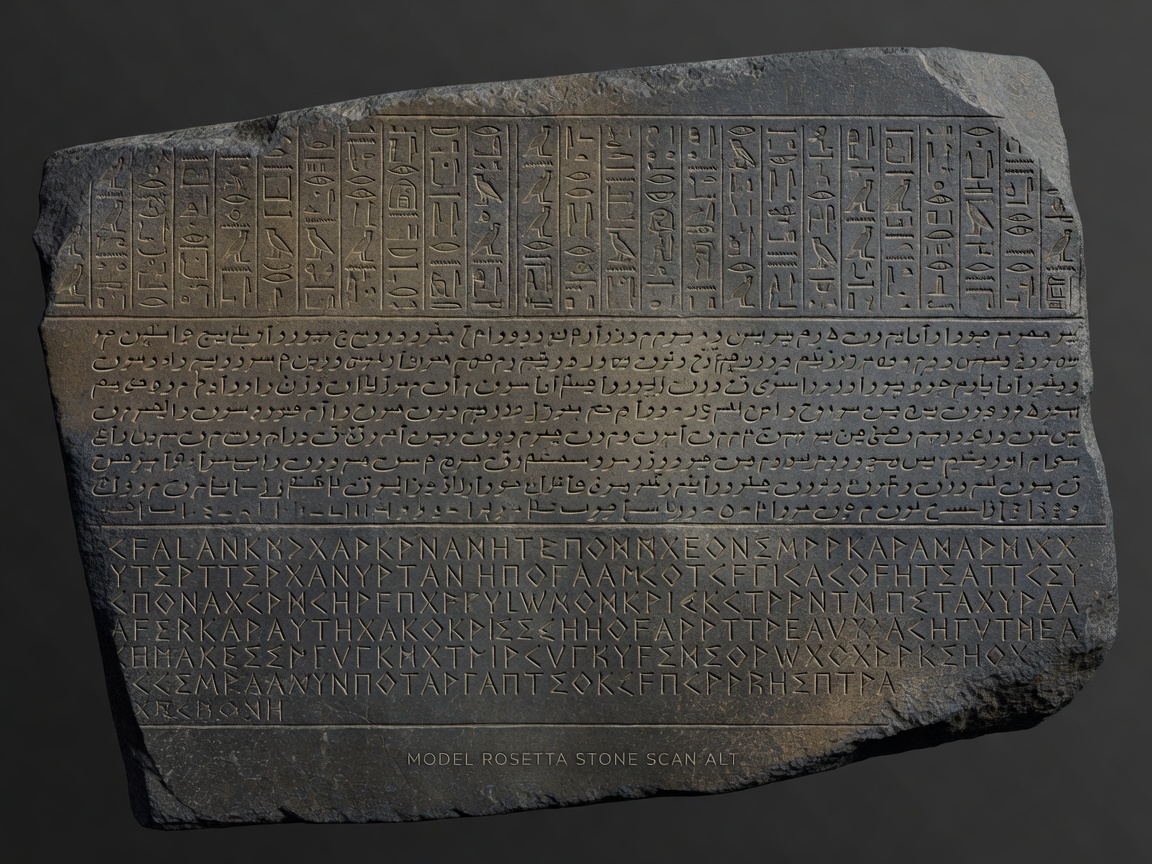
The Rosetta Stone
A granodiorite stele that provided the critical decryption key for Egyptian hieroglyphics. The physical object displays a decree issued in Memphis in 196 BCE inscribed in three scripts: Ancient Egyptian hieroglyphs, Demotic script, and Ancient Greek. The stone's irregular edges indicate it is a fragment of a larger stela.
- Material: Granodiorite (often misidentified historically as basalt)
- Discovery: 1799, near Rashid (Rosetta) by French engineers
Architectural Salvage & Reconstruction
The Pergamon Altar
A monumental construction built during the reign of King Eumenes II in the first half of the 2nd century BCE on one of the terraces of the acropolis of the ancient Greek city of Pergamon in Asia Minor. The frieze depicts the Gigantomachy, the struggle between the gods and the giants. The museum display is a massive partial reconstruction utilizing original excavated relief panels.
Parthenon Frieze Segments
Displayed in continuous sequence reflecting their original orientation on the Parthenon. The museum integrates surviving authentic Pentelic marble blocks alongside plaster casts of missing sections (some held in London as the Elgin Marbles), allowing visitors to perceive the continuous narrative of the Panathenaic procession.
Maritime Containment
The Vasa Warship
An intact 17th-century ship that sank on her maiden voyage in 1628. The object is a masterpiece of maritime archaeology, recovered from the Baltic Sea in 1961. The museum itself is a custom-built, climate-controlled shell designed exclusively to maintain the humidity levels required to prevent the polyethylene glycol-treated oak hull from degrading. The index notes the visible asymmetry in the gun decks—a primary factor in its historical capsizing.